Board Remuneration Reform: Holding State-Owned Enterprise Boards Accountable for How They Are Paid
Board Remuneration Reform: Holding State-Owned Enterprise Boards Accountable for How They Are Paid
South Africa’s State-Owned Enterprises (SOEs), including Eskom, Transnet, and South African Airways (SAA), have received over R500 billion in bailouts between 2008 and 2023, yet governance failures, corruption, and operational collapse have continued.
Despite repeated underperformance, board members (non-executive and executive) have continued to receive substantial remuneration, often with little or no link to measurable performance outcomes. For non-executive board members alone, across Eskom, Transnet and SAA from 2020-2024 we see the following:
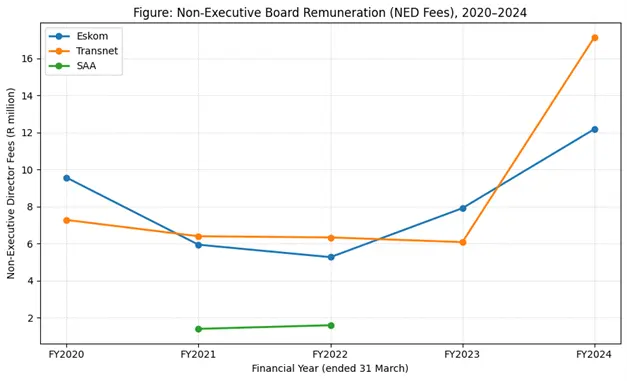
The graph compares how much non-executive board members were paid at Eskom, Transnet and SAA between FY 2020 and FY2024.
Here’s what stands out:
1. Eskom’s board pay dipped between 2020 and 2022 but then rose sharply, reaching its highest level in FY2024.
2. Transnet’s board pay stayed fairly steady for several years, before jumping significantly in FY2024.
3. SAA’s board fees were much lower overall, reflecting its reduced operations during business rescue, although data for some years is limited.
In short, board remuneration at Eskom and Transnet has increased, in some cases sharply, despite ongoing operational and financial challenges at these SOEs. Where there were dips in pay, remuneration remained high relative to average income in the country.
The key question this raises is whether board pay is truly linked to performance and accountability, especially when these entities have relied heavily on taxpayer support. To address this question OUTA’s latest research report, “Enhancing Board Remuneration Governance in South African Public Institutions: A Comparative Analysis”, investigates how remuneration is structured, regulated, and implemented in a case study of three South Africa’s SOEs, Eskom, Transnet and SAA, and compares this to international best practice.
The findings reveal a systemic failure in how public boards are paid and why reform is urgently needed.
Why This Matters
Remuneration is not just an administrative detail. How board members are paid can influence:
i. Decision-making behaviour
ii. Risk tolerance
iii. Ethical conduct
iv. Accountability culture
v. Public trust
Therefore, when remuneration is detached from performance, it can reward failure, encourage political patronage, undermine fiscal discipline and erode constitutional accountability.
In the context of SOEs that depend on taxpayer support, remuneration governance becomes a constitutional and fiscal issue, not merely a corporate one.
What We Found
Using a structured governance framework, the report evaluates four key variables:
1. Independence in remuneration-setting
2. Performance-linked pay
3. Transparency and disclosure
4. Protection against political interference
Across Eskom, SAA and Transnet, the pattern is clear:
Independence is Weak: Remuneration committees often lack autonomy and operate under ministerial discretion. Politically influenced board appointments indirectly influence how remuneration decisions are made.
Performance Linkage is Absent: Bonuses and retainers have been awarded despite operational collapse, business rescue, escalating debt, load shedding and corruption scandals. There is little consistent correlation between pay and measurable institutional outcomes.
Transparency is Inconsistent: Although legislation such as the PFMA and Companies Act requires disclosure, reporting remains irregular, delayed, incomplete and insufficiently interrogated by Parliament.
Political Interference is High: The Zondo Commission demonstrated how boards at Eskom and Transnet were compromised by patronage networks and cadre deployment. Remuneration decisions were not insulated from these dynamics.
How South Africa Compares Internationally
The report benchmarks South Africa against New Zealand, India and Canada. These countries demonstrate that structured, rules-based remuneration governance is achievable. International best practice includes:
i. Standardised remuneration bands
ii. Performance-linked incentives
iii. Mandatory public disclosure
iv. Independent remuneration committees
v. Transparent, merit-based board appointments
In contrast, South Africa lags on all four governance variables.
What Needs to Change
The report proposes practical reforms aligned to international experience:
Legislate Performance-Linked Pay: Amend the PFMA to require measurable performance metrics tied to remuneration.
Establish Independent Remuneration Committees: Insulate pay decisions from ministerial discretion and political influence.
Mandate Full Public Disclosure: Require annual publication of remuneration policies, pay ratios and bonus criteria.
Strengthen Civil Society Oversight: Empower independent watchdogs to review and challenge remuneration decisions.
When SOE boards are rewarded despite institutional collapse, constitutional principles are undermined. Remuneration reform is therefore part of a broader project of state renewal.
The Bottom Line
South Africa does not lack governance frameworks. It lacks enforcement, insulation from political interference, and binding performance standards.
International examples show reform is possible however without structural change, bailouts will continue, governance failure will persist and public trust will erode further. If there is reform, we can hope to expect pay that aligns with performance, an improvement in fiscal discipline, and SOEs returning to their developmental mandate.
Next steps
Building on the report’s findings, OUTA has announced a continued partnership with the Konrad Adenauer Stiftung (KAS) for 2026 to advance practical governance reforms. The collaboration will focus on translating research into policy implementation through:
• Publication of targeted policy position papers
• Engagement with Parliament and oversight institutions
The 2026 initiative aims to support evidence-based reform that enhances transparency, accountability, and constitutional governance in public institutions.
Read the Full Report
To explore the full analysis, data tables, international comparisons and legislative recommendations, download the complete report here.